
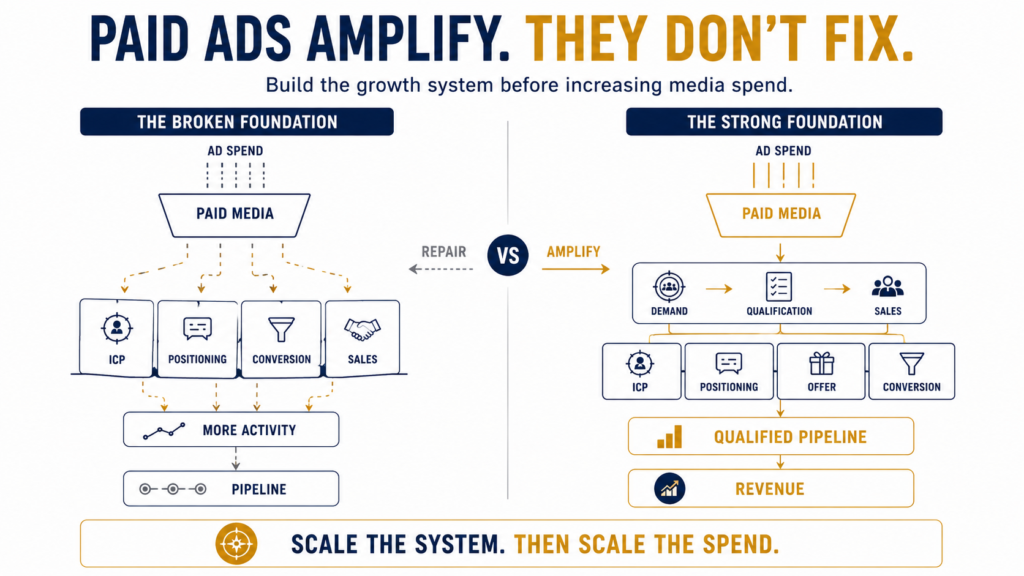
For B2B SaaS companies, paid ads for b2b saas can accelerate demand, reach defined buyer segments, and support pipeline creation. But advertising is not automatically a growth solution. Without clear positioning, a defined ICP, sufficient conversion infrastructure, and reliable measurement, paid media can simply increase the cost of acquiring attention.
The strategic question is therefore not whether a company should advertise. It is whether paid acquisition fits the company’s current growth system.
Companies considering performance marketing services USA should evaluate paid media against their sales cycle, customer economics, existing demand, conversion rates, and ability to turn qualified interest into revenue.
Why Paid Advertising Works for Some B2B Companies
Paid advertising can be valuable when a business already understands who it serves and what problem it solves.
It is particularly useful when the company needs to:
- Reach a defined B2B audience
- Enter a new market
- Generate demand around an established offer
- Retarget existing prospects
- Support an account-based strategy
- Create additional pipeline alongside organic channels
- Test positioning or offers with measurable traffic
For example, a U.S. B2B SaaS company selling workflow software to mid-market operations teams may use paid media to reach specific job functions while using content and sales outreach to develop the opportunity.
The important distinction is between traffic generation and demand generation.
| Paid Activity | Business Question |
| Impressions | Are we reaching the intended market? |
| Clicks | Is the message generating interest? |
| Leads | Are prospects taking action? |
| Qualified leads | Are we attracting the right buyers? |
| Opportunities | Is marketing creating sales conversations? |
| Pipeline | Is advertising influencing commercial value? |
| Revenue | Is acquisition producing business results? |
A B2B growth marketing agency should therefore be evaluated on how its paid strategy connects with the broader revenue process, not only on click volume.
When Paid Ads Make Sense
Paid media generally becomes more attractive when several conditions are already present.
1. The ICP Is Clear
If the company cannot define its target customer, paid advertising can make an unclear market problem more expensive.
2. The Offer Is Proven
Advertising a proposition that has not been validated can create large amounts of low-quality traffic without improving conversion.
3. The Economics Support Acquisition
The company should understand its customer value, sales cycle, expected conversion rates, and acceptable acquisition cost.
4. Conversion Infrastructure Exists
Landing pages, forms, qualification, CRM processes, sales follow-up, and attribution should be sufficiently developed.
5. The Sales Team Can Handle Demand
Generating more leads does not help if qualified prospects wait days for follow-up or sales capacity is already constrained.
This is why growth strategy consulting should precede aggressive channel expansion when fundamental growth constraints remain unresolved.
When Paid Ads Do Not Make Sense
Paid advertising is usually a poor first move when:
- ICP definition is unclear
- Positioning changes frequently
- Sales conversion is weak
- Customer retention is problematic
- The website does not communicate clear value
- Lead qualification is poorly defined
- CRM attribution is unreliable
- The company cannot distinguish leads from qualified opportunities
- The sales team lacks capacity
- The business expects immediate revenue from a long B2B buying cycle
Consider a startup selling a complex enterprise platform with a six-month sales cycle. Spending heavily on search ads before establishing qualification and sales follow-up may generate activity while providing little useful pipeline visibility.
In such a situation, business growth consulting may have greater immediate value than increasing media spend.
Choosing the Right Paid Channel
No single channel is automatically best for B2B.
The choice should follow buyer behavior, deal economics, intent, and targeting requirements.
| Channel | Strongest Use | Key Consideration |
| Professional targeting and account-based reach | Higher media costs can require strong economics | |
| Google Search | Capturing existing demand | Limited by available search demand |
| Display | Awareness and retargeting | Requires careful audience and frequency management |
| YouTube | Education and category awareness | Better suited to longer consideration journeys |
| Industry publications | Niche audience reach | Requires audience-quality validation |
| Retargeting | Re-engaging known prospects | Works best with sufficient first-party traffic |
For B2B companies, linkedin growth marketing b2b can be useful when the target audience is identifiable by role, industry, company characteristics, or account list.
However, paid media should not operate independently from demand generation analytics.
The right channel is the one that contributes to qualified commercial activity at an acceptable cost.
Paid Media and Demand Generation
One common mistake is treating paid advertising as synonymous with demand generation.
They are related, but they are not identical.
Paid media buys access to audiences. Demand generation builds market interest and buying readiness.
A strong system may combine:
Paid reach → Educational content → Retargeting → Lead capture → Qualification → Sales engagement → Opportunity → Revenue
This is also where account based marketing vs demand generation becomes an important strategic consideration.
An account-based motion may prioritize a defined list of high-value companies. A broader demand generation approach may create awareness and interest across a larger addressable market.
The right choice depends on deal size, market maturity, sales capacity, and buying behavior.
For a SaaS company selling high-value enterprise contracts, a tightly targeted account strategy may be more appropriate than optimizing for large volumes of inexpensive leads.
Measuring Paid Advertising ROI
The most important shift in B2B paid media measurement is moving from platform metrics toward business metrics.
A practical measurement hierarchy is:
Spend → Traffic → Leads → Qualified Leads → Opportunities → Pipeline → Revenue
Track at least:
| Metric | Why It Matters |
| Cost per click | Indicates media efficiency |
| Conversion rate | Shows landing-page and offer effectiveness |
| Cost per lead | Measures lead acquisition cost |
| Cost per qualified lead | Improves quality assessment |
| Opportunity rate | Connects marketing to sales |
| Pipeline generated | Measures commercial contribution |
| Customer acquisition cost | Measures acquisition efficiency |
| Revenue influenced | Connects investment to business value |
A reliable b2b marketing attribution model should account for the fact that B2B buyers often interact with multiple channels before purchasing.
For example, a prospect may:
- See a LinkedIn advertisement
- Read a research article
- Search the company on Google
- Attend a webinar
- Speak with sales
- Become an opportunity
- Purchase several months later
Giving all credit to the final conversion event can obscure how paid media contributed to the journey.
Demand generation analytics should therefore combine channel performance with CRM and revenue data wherever possible.
Budgeting Paid Ads Strategically
There is no universal starting budget that guarantees meaningful results.
Budget decisions should begin with the economics of the business.
A simple planning framework is:
Target Opportunities × Required Cost per Opportunity = Required Acquisition Investment
Then test whether the resulting investment is commercially reasonable relative to expected customer value and sales capacity.
Start with a controlled test rather than attempting to scale immediately.
Paid Media Test Framework
Step 1: Define the business objective
Choose one primary goal, such as qualified opportunities or pipeline creation.
Step 2: Define the audience
Specify ICP, buying roles, industries, company sizes, or target accounts.
Step 3: Define the offer
Use an offer appropriate to the buying stage rather than sending every audience directly to a sales conversation.
Step 4: Establish tracking
Connect advertising data to CRM stages wherever possible.
Step 5: Run controlled experiments
Test audience, message, offer, landing page, and creative systematically.
Step 6: Evaluate downstream performance
Do not scale based solely on clicks or leads. Examine qualification, opportunity creation, pipeline, and eventual revenue signals.
A growth marketing agency USA can support execution, but strategic ownership should remain connected to the company’s broader GTM and revenue priorities.
Common Mistakes
1. Optimizing for cheap leads
Low CPL does not necessarily mean high-quality pipeline.
2. Scaling before proving conversion
More traffic amplifies both effective and ineffective parts of the funnel.
3. Ignoring sales capacity
Marketing-generated demand has little value if the sales organization cannot respond effectively.
4. Using one message for every buyer
A founder, technical evaluator, and financial decision-maker may care about different outcomes.
5. Measuring only platform performance
Advertising dashboards cannot provide the complete picture of revenue contribution.
6. Treating paid media as a standalone strategy
Paid advertising should reinforce positioning, content, sales enablement, and broader B2B marketing efforts.
7. Expecting paid ads to solve strategic problems
Advertising cannot compensate for unclear positioning, weak product-market fit, poor qualification, or broken sales processes.
For growth-stage businesses, GrowAnant approaches paid acquisition as part of a broader growth system. The focus is on connecting growth consulting services, demand generation, channel execution, and revenue measurement rather than treating advertising as an isolated tactic.
Frequently Asked Questions
It can be, but only when the company has sufficient clarity around its ICP, positioning, offer, conversion process, and acquisition economics. Early-stage companies should generally use paid media to test specific hypotheses rather than assume higher spending will automatically produce sustainable growth.
There is no universal budget. A reasonable starting investment depends on target audience size, channel costs, sales cycle, expected conversion rates, customer economics, and available sales capacity. A controlled test should be large enough to produce useful learning but small enough to limit financial exposure.
The best channel depends on buyer behavior and the commercial model. LinkedIn can be useful for professional and account-based targeting, while Google Search can capture existing demand. Retargeting can support prospects already familiar with the company. Channel selection should be based on qualified pipeline contribution rather than reach alone.
True B2B paid-media ROI should connect advertising investment to downstream commercial outcomes. Track the progression from spend and traffic through qualified leads, opportunities, pipeline, customers, and revenue. Because B2B buying journeys involve multiple interactions, attribution should be interpreted as a measurement framework rather than a claim that one channel independently created every sale.