
Choosing the best growth consulting for early-stage saas founders is less about finding the most experienced consultant and more about finding the right strategic fit for the company’s current stage. Early SaaS businesses often have limited budgets, evolving positioning, incomplete customer data, and an unclear path from product traction to predictable revenue. That makes SaaS growth consulting fundamentally different from hiring a large marketing team or a generalist digital growth agency.
At this stage, the right advisor should help answer a more important question: What should we solve first to create evidence of repeatable growth?
A strong consultant connects product-market fit, positioning, customer acquisition, demand generation, and revenue economics rather than treating marketing as an isolated function.
Why Early-Stage SaaS Needs a Different Approach
Early-stage SaaS companies cannot afford to optimize everything simultaneously. A founder may be managing product development, customer conversations, sales, fundraising, hiring, and marketing while trying to determine which market segment has the strongest potential.
This is where growth strategy consulting differs from conventional marketing execution.
For an early-stage company, growth usually depends on answering five questions:
- Who is the highest-value customer?
- What problem is sufficiently important to create buying urgency?
- Why should that customer choose this product?
- Which acquisition channel can generate qualified learning efficiently?
- What evidence indicates that the business is becoming repeatable?
McKinsey’s research on SaaS emphasizes that product-market fit comes before aggressive go-to-market scaling. Once product-market fit is established, companies can move toward go-to-market fit and eventually scale.
That distinction matters because increasing advertising spend cannot compensate for weak positioning, poor customer retention, or an unclear ICP.
Consider a U.S. B2B SaaS startup selling workflow software to mid-sized logistics companies. If the founder has only a handful of customers, the immediate objective may not be generating hundreds of leads. It may be identifying which customer profile experiences the strongest pain, achieves the fastest value, and is most likely to expand.
The consultant’s role should therefore be to create business clarity before marketing volume.
What to Prioritize at This Stage
The highest-value growth consulting services for an early-stage SaaS company should prioritize learning, validation, and repeatability.
| Priority | Strategic Question | Expected Business Value |
| ICP definition | Who has the strongest need and buying potential? | Better targeting |
| Positioning | Why should customers choose us? | Stronger differentiation |
| GTM model | How should we reach and convert customers? | Efficient acquisition |
| Demand generation | Which channels create qualified demand? | Pipeline development |
| Funnel analysis | Where are prospects dropping? | Better conversion |
| Retention | Are customers receiving ongoing value? | Stronger growth foundation |
| Growth roadmap | What should happen next? | Better resource allocation |
A good business growth consulting engagement should therefore begin with diagnosis rather than immediately recommending paid media, content, SEO, or outbound campaigns.
The Early-Stage Growth Priority Model
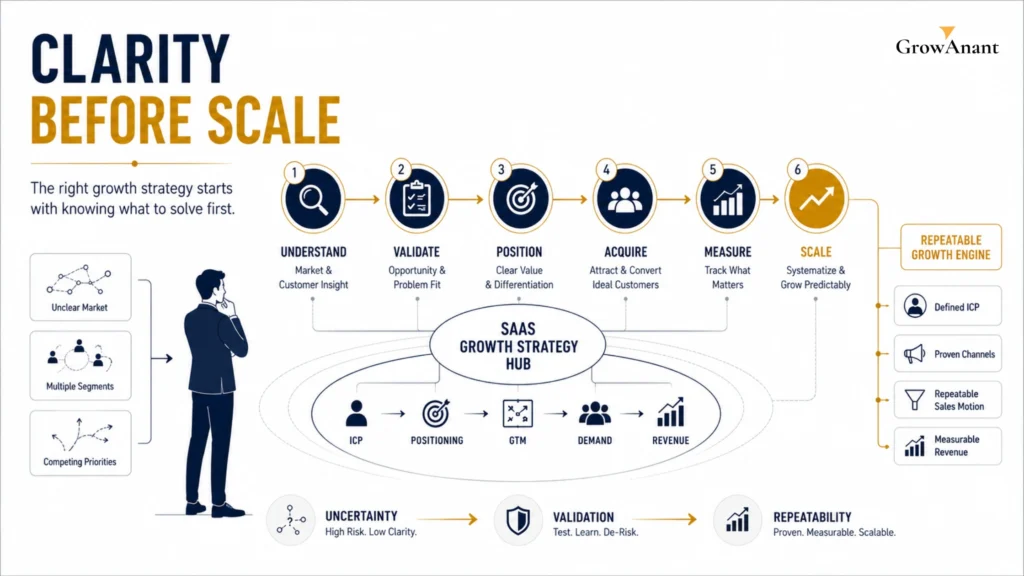
1. Understand → 2. Validate → 3. Position → 4. Acquire → 5. Measure → 6. Scale
This sequence prevents a common founder mistake: scaling an acquisition channel before proving that the underlying proposition works.
For example, a SaaS company might discover through customer interviews that its strongest buyers are not startups, as originally assumed, but operations teams at established mid-market businesses. That insight could change its messaging, pricing, sales process, content strategy, and channel priorities.
This is where startup growth strategy consulting and growth roadmap consulting can provide more value than isolated marketing execution.
Evaluating Consultants for Product-Market Fit Support
The best growth consulting for early-stage saas founders should not be judged primarily by the consultant’s number of years in marketing.
Founders should evaluate whether the consultant can connect strategy to evidence.
A useful evaluation framework is the FIT Framework:
| Dimension | What to Evaluate | Warning Sign |
| F: Founder Fit | Can they work directly with founders and leadership? | Requires multiple layers of management |
| I: Insight | Can they diagnose ICP, positioning, funnel, and GTM issues? | Starts with tactics immediately |
| T: Traction Logic | Can they define measurable learning and growth milestones? | Focuses only on traffic or lead volume |
A strong SaaS growth consulting partner should also understand that product-market fit is not simply a marketing problem.
Important signals can include:
- customer retention
- product adoption
- repeat usage
- customer expansion
- sales conversion
- customer acquisition economics
- speed to value
- qualitative customer feedback
McKinsey highlights retention and customer adoption as important indicators of SaaS product-market fit and customer value.
Questions Founders Should Ask
Before selecting a consultant, ask:
- How would you diagnose our current growth constraint?
- What would you investigate before recommending channels?
- How would you define our ideal customer profile?
- How would you test positioning?
- What would you measure in the first 90 days?
- How would you distinguish a product problem from a marketing problem?
- What would make you recommend not increasing marketing spend?
The last question is particularly revealing.
A strategic advisor should be willing to say, “Do not scale this yet,” when the evidence does not support scaling.
Budget-Conscious Engagement Models
Early-stage founders often need senior expertise without committing to the cost of a full internal growth leadership team.
This creates several possible growth consulting business models.
| Model | Best For | Strength | Limitation |
| Project-based | Specific strategic problem | Clear scope | Limited continuity |
| Advisory retainer | Founder needing ongoing guidance | Consistent strategic input | Requires internal execution |
| Fractional leadership | Company needing ownership | Senior strategic involvement | Higher commitment |
| Hybrid | Strategy plus execution support | Strong balance | Requires clear responsibilities |
A fractional growth consultant can be particularly useful when a startup has capable marketers or salespeople but lacks senior growth leadership.
The consultant can establish priorities, define KPIs, align marketing and sales, review experiments, and guide the team without requiring the company to immediately hire a full-time executive.
The ideal growth consulting engagement structure should be tied to business maturity.
A Practical 90-Day Structure
Days 1–30: Diagnose
- ICP analysis
- customer and competitor research
- positioning review
- funnel assessment
- channel analysis
- baseline metrics
Days 31–60: Validate
- positioning tests
- messaging experiments
- channel experiments
- demand-generation tests
- sales process improvements
Days 61–90: Build
- prioritized growth roadmap
- scalable channel plan
- KPI dashboard
- experimentation process
- internal ownership model
This approach keeps investment focused on learning and business outcomes rather than producing activity for its own sake.
For a founder comparing growth consulting services, business growth agency USA, or a growth marketing agency USA, the key question should be: Who will help me decide what deserves investment before my budget is committed?
Red Flags for Early-Stage Founders
The wrong advisor can create expensive distractions.
Red Flag 1: Tactics Before Diagnosis
If the first recommendation is immediately “run Google Ads,” “publish 20 blogs,” or “increase LinkedIn posting,” the consultant may be optimizing activity rather than solving the growth constraint.
Red Flag 2: Vanity Metrics
Traffic, impressions, followers, and raw lead volume can be useful indicators, but founders ultimately need to understand pipeline quality, conversion, customer acquisition economics, retention, and revenue contribution.
Red Flag 3: One-Size-Fits-All GTM
A product-led SaaS business, enterprise cybersecurity platform, vertical SaaS company, and professional services business require different acquisition and sales models.
A consultant offering identical strategies to all of them should be evaluated carefully.
Red Flag 4: No Founder Involvement
Early-stage growth frequently requires decisions about positioning, pricing, customer segments, product priorities, and sales. A consultant who cannot engage with the founder or leadership team may struggle to influence those decisions.
Red Flag 5: No Clear Measurement System
A credible revenue growth consulting engagement should establish what success means before execution begins.
A simple founder checklist is:
Before signing, confirm that the consultant can:
- Diagnose the current growth constraint
- Define or refine the ICP
- Evaluate product-market fit signals
- Clarify positioning
- Build a prioritized growth roadmap
- Connect marketing activity to pipeline
- Establish measurable KPIs
- Explain what should not be prioritized
- Work within realistic budget constraints
- Transfer knowledge to the internal team
This is also where a brand growth consulting comparison becomes useful. Founders should compare providers based on strategic depth, engagement structure, founder access, measurement discipline, and ability to connect GTM decisions to revenue, not simply hourly rates or the number of services offered.
For an early-stage SaaS company, the right partner may ultimately look less like a traditional agency and more like an external growth leadership function. GrowAnant approaches this model as a growth partner that connects growth consulting, demand generation, GTM planning, and revenue-focused execution.
The objective is not to make the company dependent on external execution. It is to help founders establish a clearer growth system that the business can eventually operate and scale internally.
Frequently Asked Questions
Early-stage founders should prioritize ICP clarity, positioning, product-market fit signals, GTM strategy, customer acquisition economics, and a measurable growth roadmap before aggressively scaling marketing channels.
Yes. A consultant can help identify customer segments, validate positioning, analyze acquisition and retention signals, structure experiments, and determine whether the primary constraint is product, market, positioning, sales, or marketing.
The appropriate budget depends on the company’s stage, complexity, internal capabilities, and scope of work. Project-based advisory, retainers, fractional leadership, and hybrid models can provide different levels of senior support without immediately building a full internal growth function.
The biggest red flags include tactics-first recommendations, vanity-metric reporting, generic GTM strategies, unclear measurement, limited founder involvement, and consultants who cannot explain which growth activities should be delayed or avoided.