
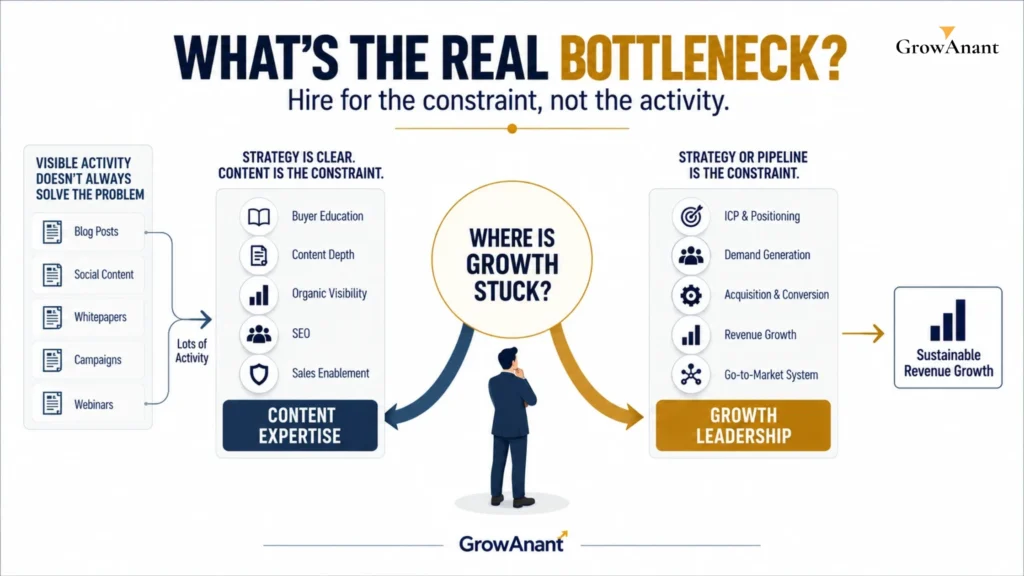
Choosing between a content marketing consultant vs agency is not simply a question of who can produce more content. For a growth-stage SaaS company, professional services firm, or founder-led business, the more important question is whether content is actually the constraint preventing revenue growth.
A growth marketing consultant looks across the broader growth system: positioning, acquisition, demand generation, conversion, customer economics, funnel performance, and revenue attribution. A content-focused consultant concentrates more deeply on the content system itself, including strategy, topics, production, distribution, SEO, and content performance.
The distinction matters because a company can have excellent content and still experience weak pipeline. Conversely, a company with strong positioning and demand generation may be losing opportunities because it lacks the content required to educate buyers.
The decision should therefore begin with the bottleneck, not the service category.
Scope Differences
The fundamental difference is scope.
A content marketing consultant typically owns or advises on the content engine. A growth consultant evaluates how multiple parts of the commercial system work together.
| Area | Content Marketing Consultant | Growth Marketing Consultant |
| Content strategy | Primary responsibility | Strategic input |
| SEO/content planning | Strong focus | Evaluates role within growth |
| Positioning | Usually supporting | Core responsibility |
| Demand generation | Content-led | Multi-channel |
| Paid acquisition | Limited or supporting | Often evaluated |
| Funnel optimization | Content journey | End-to-end funnel |
| Attribution | Content performance | Revenue and pipeline |
| GTM | Content contribution | Broader GTM strategy |
| Customer acquisition | Content-assisted | End-to-end |
| Revenue strategy | Indirect | Direct focus |
For example, imagine a U.S. B2B SaaS company publishing four articles per month but generating very few qualified opportunities.
A content specialist might identify weak topics, search intent, distribution, or conversion paths.
A growth consultant would ask a broader set of questions:
- Is the ICP specific enough?
- Does the positioning create urgency?
- Are the right accounts discovering the company?
- Is there a demand problem or a conversion problem?
- Are sales and marketing targeting the same buyers?
- Which channels influence pipeline?
- Is content reaching buying committees?
- Where does funnel leakage occur?
This broader view is why growth marketing services should not be treated as simply “more content.”
For a VP Marketing, the distinction becomes especially important when the organization has limited budget and needs to decide whether the next investment should go into content, paid acquisition, outbound, sales enablement, conversion optimization, or strategic repositioning.
When Content Is the Bottleneck
Content is the bottleneck when the company already has reasonable strategic clarity but lacks the educational assets required to attract, inform, and convert its target buyers.
This is common in complex B2B markets where buyers require substantial education before engaging with sales.
HubSpot’s current content guidance emphasizes defining the audience, setting goals and KPIs, selecting appropriate formats and channels, distributing content, and measuring performance rather than treating content creation as an isolated publishing activity.
Signs Content Is the Bottleneck
A company should consider a content specialist when:
- The ICP is clearly defined.
- Positioning is relatively strong.
- Customers have identifiable questions and objections.
- Organic visibility is weak.
- Existing content does not address buyer intent.
- Sales teams repeatedly answer the same educational questions.
- There is little middle-of-funnel content.
- Product expertise exists internally but is not being converted into useful assets.
- Content performance is not being measured against business objectives.
A B2B cybersecurity company, for example, may have strong product-market fit and an established sales process but lack content explaining regulatory requirements, security risks, implementation considerations, and competitive differentiation.
In that situation, a content-focused engagement can be highly valuable.
The Content Bottleneck Test
Ask five questions:
1. Do we know exactly who we are targeting?
2. Do we know what those buyers care about?
3. Is our positioning already clear?
4. Are qualified prospects finding us but lacking sufficient information to progress?
5. Can we connect content consumption to engagement, leads, opportunities, or pipeline?
If the answer to most of these is yes, content may genuinely be the constraint.
This is where a B2B growth marketing agency can combine content with broader demand generation, but the company should still establish whether content or strategy is the primary issue.
When Growth Strategy Is the Bottleneck
Growth strategy becomes the bottleneck when marketing activity exists but the company cannot clearly explain how that activity translates into qualified pipeline and revenue.
Common symptoms include:
- Rising CAC
- inconsistent lead quality
- multiple channels with unclear attribution
- disconnected sales and marketing teams
- low conversion rates
- unclear ICP
- weak differentiation
- frequent campaign changes
- content that generates traffic but little pipeline
- paid campaigns that generate leads but poor opportunities
- no clear growth roadmap
In this situation, hiring a content specialist may improve output without solving the underlying problem.
A growth consultant would first examine the entire system.
The Growth Bottleneck Framework
Market → Positioning → Demand → Acquisition → Conversion → Revenue → Retention
The objective is to identify the weakest link.
For instance, consider a U.S. HR SaaS company investing heavily in LinkedIn content. Posts receive engagement, website traffic is increasing, and the content calendar is active, but sales-qualified opportunities remain low.
The problem may not be content quality.
The real issue could be:
Broad audience → weak ICP → generic messaging → low buying intent → poor pipeline quality
In that scenario, additional content production may simply amplify the wrong strategy.
A growth engagement could instead focus on ICP refinement, positioning, demand generation, lead qualification, funnel design, and channel prioritization.
This is also where demand generation analytics and a b2b marketing attribution model become important.
McKinsey’s research indicates that B2B organizations using commercial analytics effectively are more likely to achieve above-average growth, reinforcing the importance of connecting marketing and sales activity to measurable commercial outcomes.
Can One Consultant Do Both?
Yes, but founders and marketing leaders should distinguish between breadth of understanding and depth of specialization.
A strong growth consultant should understand content well enough to determine:
- what content the market needs
- which buyer questions matter
- where content fits within the funnel
- which topics support demand generation
- how content influences conversion
- how content contributes to pipeline
However, that does not necessarily mean the consultant should personally perform every writing, editing, SEO, design, and distribution function.
Similarly, a strong content consultant should understand how content contributes to the broader growth system.
The ideal structure depends on the company’s needs.
| Business Situation | Best Fit |
| Strategy is clear, content execution is weak | Content consultant |
| Content exists, pipeline is weak | Growth consultant |
| ICP and positioning are unclear | Growth consultant |
| Organic visibility is the main gap | Content specialist |
| Multiple channels are underperforming | Growth consultant |
| Content and growth both need alignment | Growth-led model with content expertise |
| Internal team executes but lacks leadership | Fractional growth leadership |
This distinction prevents a common mistake: hiring a specialist to solve a leadership problem.
A company with an execution team but no strategic direction may need growth consulting services, business growth consulting, or growth strategy consulting before adding another production resource.
GrowAnant approaches this challenge by connecting strategy, demand generation, GTM decisions, and revenue execution rather than treating content as a standalone marketing function.
Decision Framework
The simplest way to choose is to identify where the business is losing momentum.
The BOTTLE Framework
| Question | If “Yes” | Priority |
| B: Buyers defined? | ICP is unclear | Growth strategy |
| O: Offer differentiated? | Positioning is weak | Growth strategy |
| T: Traffic/content working? | Qualified buyers cannot find or learn from you | Content |
| T: Transition to pipeline? | Leads do not become opportunities | Growth |
| L: Lead quality strong? | Lead volume exists but quality is weak | Growth |
| E: Evidence measurable? | Attribution is unclear | Growth analytics |
Choose a Content Consultant When:
- Your strategy is already clear.
- Your ICP is established.
- Your primary gap is content depth or consistency.
- Organic acquisition is strategically important.
- Sales needs stronger educational assets.
- Content performance is measurable.
Choose a Growth Consultant When:
- You are unsure what channel deserves investment.
- Pipeline is inconsistent.
- Marketing and sales are misaligned.
- CAC is increasing.
- Positioning is unclear.
- Your team executes but lacks strategic leadership.
- You need a coordinated GTM roadmap.
Consider Both When:
Strategy + execution are both constrained.
In that model, the growth leader establishes priorities, measurement, positioning, funnel architecture, and channel strategy while content specialists execute the content system.
A practical 90-day approach could look like this:
Days 1 to 30: Diagnose
- ICP
- positioning
- funnel
- existing content
- channel performance
- attribution
- competitive landscape
Days 31 to 60: Prioritize
- growth bottleneck
- content gaps
- demand-generation priorities
- channel experiments
- measurement framework
Days 61 to 90: Execute and Learn
- launch priority initiatives
- measure qualified pipeline
- review conversion
- refine messaging
- reallocate resources
The most important principle is simple:
Do not hire for the activity you can see. Hire for the constraint you need to solve.
If the business has plenty of content but insufficient pipeline, more content may not be the answer. If strategy is strong but the company lacks the educational assets needed to influence buyers, content may be the missing piece.
For VP Marketing and growth leaders, this decision ultimately comes down to one question:
Is the business struggling to create valuable information, or struggling to turn marketing activity into predictable revenue?
The first points toward content expertise. The second points toward growth leadership.
References
Frequently Asked Questions
A content marketing consultant focuses primarily on content strategy, creation, distribution, SEO, and content performance. A growth marketing consultant evaluates the broader growth system, including positioning, acquisition, demand generation, conversion, attribution, and revenue impact.
Yes. A capable growth consultant should understand content strategy and its role in the buyer journey. However, depending on the company’s content requirements, specialized writers, SEO experts, or content teams may still be needed for execution.
Start with the full growth journey from market and positioning through demand, acquisition, conversion, and revenue. If strategy, ICP, positioning, or pipeline economics are unclear, the issue is likely broader than content. If the strategy is clear but buyers lack useful educational resources, content may be the primary bottleneck.
You may need both when the company has a strategic growth gap and a significant content execution requirement. In that situation, a growth leader can establish priorities and measurement while content specialists build the assets required to support demand generation and conversion.