
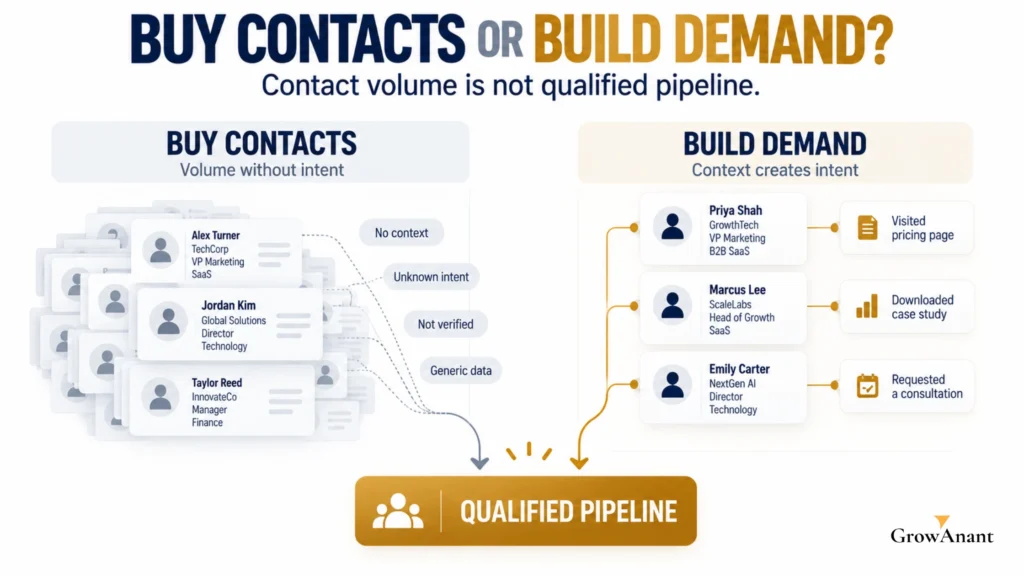
For a B2B company under pressure to create pipeline, purchasing a database can appear faster than building a demand engine. The central question behind generate lead vs buy lead is not simply how quickly contacts can be acquired. It is whether those contacts have sufficient relevance, intent, and engagement potential to contribute to qualified pipeline.
A B2B lead generation services strategy is designed to create opportunities by reaching the right audience with relevant value propositions and conversion paths. Purchased lists primarily provide contact data. The distinction matters because revenue growth depends on progressing prospects through the funnel, not simply increasing the number of names in a CRM.
For founders and marketing leaders, the decision should therefore be evaluated through four dimensions: lead quality, buyer intent, acquisition economics, and revenue contribution.
The Appeal of Buying Leads
Buying leads is attractive because it appears to solve an immediate pipeline problem.
A sales leader may have a quarterly target while marketing is still building content, campaigns, landing pages, audience segments, and attribution. A purchased database can produce thousands of contacts quickly, creating the perception of momentum.
However, contact volume and sales readiness are different measurements.
| Factor | Purchased Leads | Generated Leads |
| Acquisition speed | Usually faster | Requires ongoing execution |
| Buyer awareness | Often limited | Built through interactions |
| Intent signals | Usually limited | Can be captured progressively |
| Audience control | Depends on provider | Controlled by strategy |
| Message relevance | Often broad | Can be highly targeted |
| Data quality | Requires verification | Captured and enriched over time |
| Nurturing potential | Depends on consent and engagement | Built into the acquisition journey |
| Revenue attribution | Can be difficult | Easier when tracking is designed properly |
The problem becomes more significant when a business measures marketing success through contact volume instead of qualified opportunities.
For example, a U.S. B2B SaaS company may purchase 20,000 contacts matching an industry and job-title profile. If only a small portion recognize the company, have a current business need, or are appropriate prospects, the apparent scale does not necessarily translate into pipeline.
This is why growth marketing services should focus on the complete acquisition journey rather than simply supplying contact records.
Risks of Purchased Lists
Purchased lists create several strategic, operational, and compliance considerations.
1. Low relevance
A contact can match an ICP on paper while having no active need for the solution.
A manufacturing executive may technically fit a cybersecurity company’s target profile, but that does not mean the executive is currently evaluating cybersecurity services.
2. Weak buyer intent
Generated leads can provide behavioral signals such as content engagement, form submissions, demo requests, event participation, or repeated website activity.
A purchased contact generally starts with much less context.
3. Deliverability and reputation risk
Google’s current email guidance advises senders not to purchase email addresses and emphasizes sending commercial email to people who want to receive it.
HubSpot similarly identifies purchased, rented, or third-party contacts as problematic sources for marketing email and notes risks including bounces, spam complaints, and blocklisting.
That means the cost of a purchased list can extend beyond the list itself. Poor engagement can affect the ability to communicate effectively with prospects who actually want to hear from the company.
4. Compliance uncertainty
The fact that a vendor says a database is “opted in” does not automatically mean the individuals consented to receive marketing communications from your company.
Marketing leaders should establish:
- Where the data originated
- What permission was obtained
- What communication the permission covered
- Whether consent is transferable
- How unsubscribe requests are handled
- Which regulations apply to the target market
5. Poor sales efficiency
Sales teams can spend significant time researching, contacting, qualifying, and following up with people who were never interested.
This creates a hidden cost:
List cost + enrichment cost + outreach cost + sales time + opportunity cost
A cheaper contact is not necessarily a cheaper acquisition.
Why Generated Leads Convert Better
Generated leads have a fundamental advantage: the acquisition process can create context.
A prospect who downloads a relevant B2B guide, attends a webinar, requests a consultation, interacts with a product page, or responds to a targeted campaign has demonstrated some level of engagement.
This does not mean every generated lead is sales-ready. It means the business can observe and interpret buyer behavior.
A generation-first system typically connects:
Audience → Problem → Content or Offer → Engagement → Qualification → Sales Conversation → Opportunity → Revenue
This is where demand generation becomes different from simply collecting contacts.
A simple lead-generation framework
| Stage | Business Question | Example Signal |
| Audience | Is this the right buyer? | ICP and firmographic fit |
| Problem | Does the buyer recognize the problem? | Content engagement |
| Interest | Are they exploring solutions? | Product/service page visits |
| Intent | Are they showing buying behavior? | Demo or consultation request |
| Qualification | Does the opportunity fit? | Budget, need, authority, timing |
| Pipeline | Has sales accepted the opportunity? | SQL or opportunity creation |
| Revenue | Did the opportunity create business value? | Closed-won revenue |
For a SaaS company, this could mean building content around implementation challenges, comparison searches, use cases, and operational problems rather than simply advertising a product.
For a professional services firm, it could mean combining expertise-led content, targeted outbound, referrals, search visibility, and consultation offers.
The objective is not to eliminate outbound activity. It is to make acquisition increasingly intentional and measurable.
When Buying Leads Can Work
Buying contact data and buying “leads” should not automatically be treated as the same activity.
There are situations where externally sourced data can support a B2B acquisition strategy, particularly when it is used for research, account identification, enrichment, or targeted prospecting rather than treated as automatically sales-ready demand.
A company entering the U.S. market, for example, may use third-party data to identify companies matching a specific ICP. The strategic value comes from improving account selection, not assuming that every contact is already interested.
A useful decision framework is:
| Question | If Yes | If No |
| Is the ICP clearly defined? | Continue evaluation | Define ICP first |
| Is data provenance clear? | Evaluate compliance | Avoid the source |
| Can contacts legally be reached? | Validate outreach process | Do not proceed |
| Can data be verified? | Enrich and validate | Treat quality as a risk |
| Is there an intent signal? | Prioritize prospects | Use carefully for research |
| Can revenue impact be tracked? | Measure performance | Fix attribution first |
For businesses considering B2B lead generation services, this distinction is important. A lead database can supplement prospecting, but it should not become a substitute for building demand.
Building a Generation-First Strategy
A generation-first pipeline does not mean relying exclusively on organic content.
It means designing acquisition around the buyer and measuring progression toward revenue.
Step 1: Define the ICP
Specify:
- Industry
- Company size
- Geography
- Business model
- Decision-maker
- Pain points
- Buying triggers
- Existing alternatives
Step 2: Map demand
Separate audiences into three broad groups:
Problem-aware: They understand the challenge but may not know the solution.
Solution-aware: They are actively exploring possible approaches.
Purchase-ready: They are evaluating vendors or preparing to make a decision.
Different stages require different messages.
Step 3: Build multiple acquisition paths
A B2B company can combine:
- Search-driven content
- LinkedIn thought leadership
- Account-based outreach
- Paid search
- Retargeting
- Webinars
- Case studies
- Referral programs
- Industry partnerships
- Sales-led prospecting
For companies targeting the U.S., growth marketing agency USA capabilities can support channel coordination, but the underlying strategy should remain focused on ICP fit, intent, and revenue contribution.
Step 4: Create qualification rules
A practical qualification framework can score:
Fit + Intent + Engagement + Timing
For example:
- High ICP fit: +30
- Relevant buying behavior: +25
- High-intent page engagement: +20
- Consultation request: +25
- Poor ICP fit: negative score
The actual values should be determined from historical sales data rather than copied from a generic scoring template.
Step 5: Connect marketing to sales
Marketing should not optimize solely for leads.
Track:
Lead → Qualified Lead → Sales Accepted Lead → Opportunity → Customer
This provides a much clearer view of whether acquisition activity is contributing to revenue.
Generation-first checklist
Before investing heavily in purchased lead lists, ask:
- Is our ICP specific enough?
- Do we know which channels generate qualified opportunities?
- Can we distinguish interest from buying intent?
- Are marketing and sales using the same qualification criteria?
- Can we attribute opportunities back to acquisition sources?
- Is our CRM data structured for analysis?
- Do we have a repeatable nurture process?
- Are we measuring pipeline contribution rather than contact volume?
For growth-stage businesses, this systems perspective is often more valuable than adding another database.
Many companies discover that their real problem is not a lack of contacts. It is a lack of strategic coordination between positioning, acquisition, qualification, sales, and revenue measurement.
This is where a growth consulting partner such as GrowAnant can contribute by connecting growth strategy, demand generation, sales alignment, and measurable revenue execution rather than treating lead acquisition as an isolated marketing activity.
References
Frequently Asked Questions
Buying contact data can have a role in account research, prospect identification, or data enrichment, but businesses should distinguish contact acquisition from genuine demand generation. Before using purchased contacts for outreach, evaluate data provenance, applicable consent requirements, relevance, accuracy, and outreach compliance.
Purchased contacts may match a company’s target profile without having demonstrated interest, recognized the problem, or entered a buying process. Without intent and context, sales teams often have to create awareness and qualification from the beginning.
Compliance requirements vary by jurisdiction and communication channel. Businesses should verify how contacts were collected, what consent was obtained, whether that consent applies to the intended communication, and how unsubscribe requests will be handled. Google also advises senders not to purchase email addresses and emphasizes consent and unsubscribe mechanisms.
Start by defining the ICP, identifying high-value buyer problems, selecting acquisition channels, creating relevant offers, establishing qualification criteria, and connecting marketing activity to sales and revenue outcomes. The transition should be measured through qualified pipeline rather than simply replacing one source of contact volume with another.