
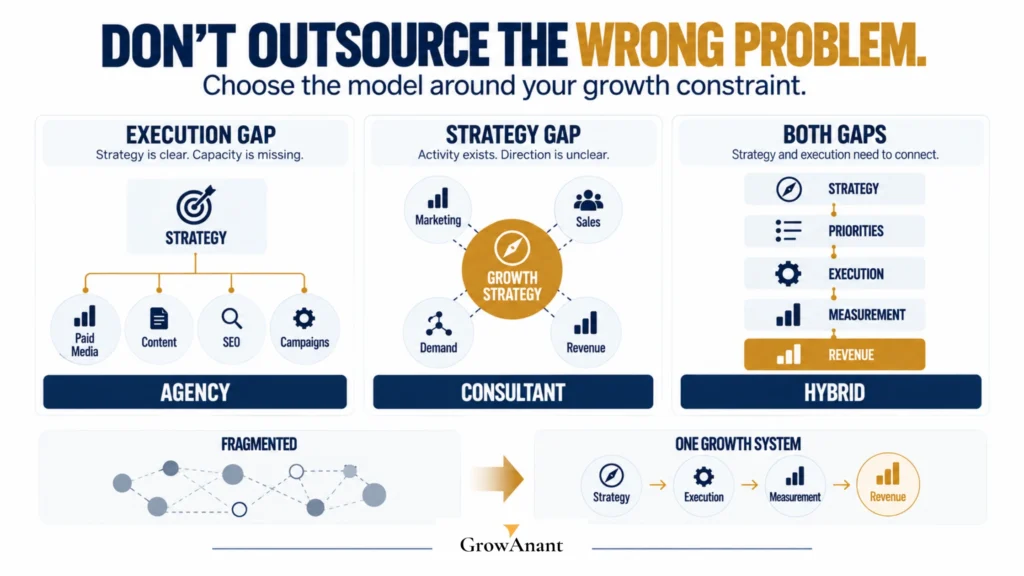
For growth-stage companies, the question of marketing agency vs consultant is rarely just about who can generate more leads. It is about who should own the system connecting market positioning, demand generation, sales pipeline, and revenue.
A marketing agency is generally built around execution and specialized delivery. A consultant is typically brought in to diagnose problems, establish strategy, prioritize initiatives, and guide decision-making. Some organizations need one. Others need both.
The right choice depends on the company’s growth stage, internal capabilities, strategic clarity, and need for execution capacity.
What Each Model Optimizes For
The fundamental difference between an agency and a consultant is what the engagement is designed to optimize.
An agency generally provides specialized execution. Depending on its capabilities, that can include paid media, SEO, content, creative, social media, outbound campaigns, or B2B lead generation services.
A consultant generally focuses on strategic direction, business diagnosis, prioritization, measurement, and organizational alignment.
| Dimension | Marketing Agency | Growth Consultant |
| Primary focus | Execution | Strategy and decision-making |
| Typical strength | Specialized delivery | Cross-functional perspective |
| Campaign management | Strong | Usually guided rather than owned |
| Growth strategy | Varies by agency | Core responsibility |
| Team alignment | Often limited to project scope | Often central to engagement |
| Revenue accountability | Depends on model | Usually tied to business objectives |
| Internal capability building | Secondary | Often part of the engagement |
| Best fit | Clear strategy + execution gap | Strategy, prioritization, or leadership gap |
For example, a SaaS company with a validated positioning strategy and clear acquisition targets may primarily need growth marketing services and execution capacity.
A founder-led B2B company with inconsistent pipeline, unclear positioning, and several disconnected marketing initiatives may first need growth strategy consulting before increasing campaign investment.
This distinction matters because adding more execution to an unclear strategy can increase activity without solving the underlying growth constraint.
McKinsey’s research on marketing operating models similarly emphasizes connecting organizational structure, governance, capabilities, and strategic direction rather than treating marketing activities as isolated functions.
Execution Depth vs Strategic Ownership
The most important question is not whether an agency or consultant is better. It is:
Who should own the growth decisions, and who should execute them?
A useful model is:
Strategy → Prioritization → Execution → Measurement → Optimization
A consultant is often positioned closer to strategy and prioritization. An agency is often positioned closer to execution.
For example:
- Consultant defines ICP and growth priorities.
- Consultant establishes the demand generation roadmap.
- Internal marketing leader approves priorities.
- Agency executes paid campaigns and creative.
- Sales team handles qualification.
- Revenue operations tracks pipeline and conversion.
- Leadership reviews business outcomes.
This creates clearer accountability.
Strategic Ownership Framework
| Responsibility | Consultant | Agency | Internal Team |
| Growth strategy | Primary | Supporting | Final ownership |
| ICP definition | Primary | Input | Primary |
| Positioning | Primary | Supporting | Primary |
| Campaign execution | Oversight | Primary | Supporting |
| Content production | Direction | Primary | Supporting |
| Paid acquisition | Strategy | Primary | Oversight |
| Sales alignment | Primary | Supporting | Primary |
| Attribution | Direction | Input | Primary |
| Revenue reporting | Primary | Supporting | Primary |
The exact structure can vary, but the principle remains consistent: execution ownership and strategic ownership do not have to sit with the same external partner.
This is particularly relevant when companies use demand generation analytics, a b2b marketing attribution model, or a lead scoring model b2b to connect marketing activity to commercial outcomes.
A consultant may determine which metrics matter and how the model should work. An agency may execute campaigns that feed the system.
Cost Structures Compared
Comparing costs requires looking beyond monthly fees.
An agency can appear more expensive because it may include several execution capabilities. A consultant can appear more expensive on an hourly or monthly basis because the engagement is focused on senior expertise.
The better comparison is total business value relative to the problem being solved.
| Cost Consideration | Agency | Consultant |
| Monthly fee | Often recurring | Often project or retainer based |
| Execution resources | Usually included | Often limited |
| Strategic leadership | Varies | Core component |
| Internal workload | Lower for execution | Higher unless execution partners exist |
| Scope flexibility | Depends on agency | Usually highly adaptable |
| Additional specialists | May be included | May require partners |
| Long-term capability building | Varies | Often explicit |
For example, a startup might spend heavily on performance marketing services USA while lacking a clear ICP or sales qualification process. The issue is not necessarily campaign execution. The business may have a strategy and operating-model problem.
Conversely, a company with strong leadership, clear positioning, and an established growth roadmap consulting process may not need additional strategic consulting. It may simply need more execution capacity from a growth marketing agency USA.
Cost should therefore be evaluated against the constraint.
If the constraint is execution capacity, an agency may solve it.
If the constraint is strategic clarity or growth ownership, a consultant may solve it.
Which Fits Growth-Stage Companies
Growth-stage companies often operate in an uncomfortable middle ground.
They have traction, some marketing resources, and an existing sales process, but growth becomes increasingly difficult to coordinate.
Typical symptoms include:
- Marketing generates leads that sales does not prioritize.
- Sales requests more leads while conversion remains weak.
- CAC increases without clear attribution.
- Different teams target different customer segments.
- Campaigns operate without a shared growth roadmap.
- Leadership cannot clearly connect marketing spend to pipeline.
- New market opportunities compete with core-market priorities.
In this environment, the marketing agency vs consultant decision should begin with a capability assessment.
Decision Framework
Choose an agency-led model when:
- Strategy is already clear.
- ICP and positioning are established.
- Internal leadership can prioritize initiatives.
- The main constraint is execution capacity.
- Campaign production is slowing growth.
- Specialized skills are missing internally.
Choose a consultant-led model when:
- Growth priorities are unclear.
- Marketing and sales are misaligned.
- Leadership lacks a unified growth roadmap.
- Acquisition costs are increasing without clear diagnosis.
- Teams are active but not coordinated.
- The company is entering a new market.
- Leadership needs senior growth ownership.
Consider a hybrid model when:
- Strategic direction is missing and execution capacity is also limited.
- The company has internal marketers but lacks senior growth leadership.
- Multiple agencies are operating without a unified strategy.
- The business needs both strategic oversight and specialized execution.
This is often relevant for B2B SaaS companies considering SaaS growth consulting, professional service companies seeking lead generation for B2B services, or startups requiring startup growth strategy consulting.
Can They Work Together?
Yes. In many growth-stage organizations, a consultant and agency can work effectively together when responsibilities are clearly defined.
The consultant should not automatically become another layer of approval. The agency should not be expected to determine the entire business strategy without sufficient commercial context.
A practical hybrid structure looks like this:
CEO / Founder
↓
Growth Consultant
Strategy, priorities, positioning, measurement
↓
Internal Marketing + Sales
Customer insight, qualification, execution ownership
↓
Specialist Agency Partners
Paid media, content, SEO, creative, campaigns
The consultant acts as the strategic connector.
For example, a U.S.-focused SaaS company may work with a growth consultant to define its ICP, positioning, demand generation strategy, funnel stages, and revenue KPIs. A specialist agency can then execute paid acquisition and content against those priorities.
This structure also prevents a common problem: hiring several specialized vendors and expecting them to collectively create a growth strategy.
GrowAnant’s positioning fits this strategic layer by acting as a growth partner that connects strategy, demand generation, go-to-market planning, and revenue execution rather than functioning only as a campaign execution vendor.
McKinsey has noted that high-performing marketing operating models increasingly require cross-functional collaboration, clear governance, defined decision rights, and external partners integrated into the broader growth strategy.
Practical Ownership Checklist
Before deciding who should own demand generation, leadership should answer:
- Is our ICP clearly defined?
- Is our market positioning established?
- Do marketing and sales share pipeline objectives?
- Can we attribute marketing activity to commercial outcomes?
- Do we have sufficient internal strategic leadership?
- Is our main constraint strategy or execution?
- Are existing agencies working from one growth roadmap?
- Does someone have clear ownership of demand generation?
- Are priorities connected to revenue rather than activity volume?
If most strategic questions remain unresolved, adding another execution partner may not address the core problem.
If strategy is clear but the organization lacks specialist capacity, execution support may be the more appropriate requirement.
The decision is therefore less about choosing between an agency and consultant in isolation and more about designing a growth system in which strategy, execution, measurement, and revenue accountability have clear owners.
Frequently Asked Questions
It depends on the company’s needs. An agency can own demand generation execution when strategy, ICP, positioning, and measurement are already established. A consultant may be better positioned to own the strategic direction when demand generation is suffering from unclear priorities, weak positioning, poor sales alignment, or limited growth leadership.
There is no universal answer. Agency costs may increase as execution scope expands, while consulting costs may be higher for senior strategic expertise. The relevant comparison is the total cost of solving the company’s specific growth constraint, including internal resources and the cost of ineffective execution.
Yes. A consultant can establish strategy, priorities, measurement, and governance while an agency executes specialized activities. This model works best when decision rights, responsibilities, KPIs, and communication processes are clearly defined.
The appropriate model depends on the company’s maturity and constraint. A company with validated positioning and a clear strategy may need execution capacity. A company still determining its market, positioning, ICP, and growth model may benefit from strategic guidance before scaling execution.