
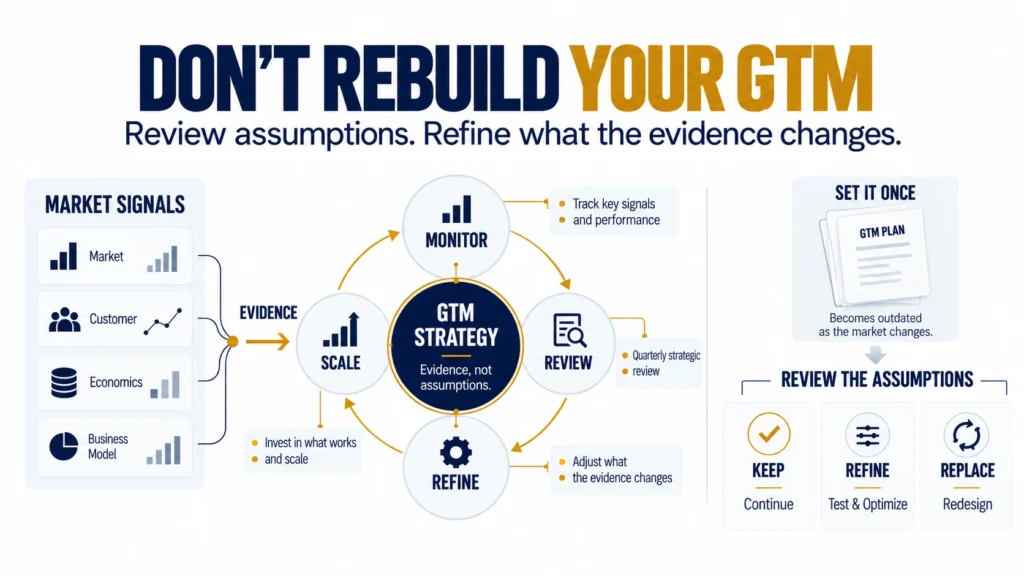
A go-to-market plan should not be treated as a document that is created once and forgotten. For founders, establishing a gtm strategy review cadence creates a structured way to evaluate whether positioning, target customers, channels, sales motion, and growth priorities still reflect market conditions.
A practical starting point is a quarterly strategic review, supported by ongoing monitoring and off-cycle reviews when significant business conditions change. This is particularly important for startups using go to market strategy consulting, market entry strategy USA, or growth strategy consulting as they move from initial traction toward repeatable growth.
The goal is not to rewrite the GTM strategy every quarter. It is to identify what has changed, what is working, what is creating friction, and which assumptions require adjustment.
Why GTM Isn’t a One-Time Exercise
A GTM strategy connects the company, its target market, positioning, commercial model, channels, and revenue objectives. HubSpot describes GTM strategy as a plan covering areas such as target audience, positioning, pricing, sales, distribution, and customer alignment.
That means the strategy depends on assumptions.
If customer behavior changes, competitors reposition, CAC rises, a new segment becomes attractive, or the sales cycle changes, the assumptions behind the GTM plan may no longer hold.
For example, consider a U.S. SaaS startup that initially targets small businesses through founder-led sales. After six months, it discovers that larger companies have stronger retention and higher contract values. The original GTM plan may still be directionally useful, but its ideal customer profile, pricing, sales process, and channel priorities may need adjustment.
A GTM review therefore asks:
| Area | Review Question |
| Market | Has the addressable opportunity changed? |
| Customer | Are the highest-value customers still the original ICP? |
| Positioning | Does the message clearly differentiate the offer? |
| Acquisition | Which channels are producing qualified opportunities? |
| Sales | Has the sales cycle or buying committee changed? |
| Revenue | Are acquisition activities translating into pipeline and revenue? |
| Expansion | Are new markets or segments becoming viable? |
For growth-stage companies, business growth consulting and growth roadmap consulting can help leadership turn these observations into structured strategic decisions rather than isolated marketing changes.
Signs It’s Time for a Review
A scheduled quarterly review is useful, but founders should not wait for the calendar when important signals appear.
Common triggers include:
- Qualified lead volume declines despite consistent marketing activity.
- CAC increases without a corresponding increase in customer value.
- Conversion rates decline at a specific funnel stage.
- The original ICP produces fewer opportunities than expected.
- A new customer segment begins generating stronger revenue or retention.
- Competitors introduce materially different positioning.
- The company enters a new geography.
- Pricing or packaging changes.
- The sales cycle becomes longer.
- Product adoption differs from the assumptions in the original plan.
- The company moves from founder-led sales toward a dedicated sales team.
- A new channel begins producing meaningful demand.
For an international startup entering the U.S., us market entry consulting for indian companies or other market-specific expertise can be particularly relevant when customer expectations, buying processes, competitors, and distribution models differ from the company’s home market.
A useful trigger framework is:
Change in Market + Change in Customer + Change in Economics + Change in Business Model = GTM Review
The review does not necessarily mean a complete strategic reset. It means identifying which assumptions have changed enough to require action.
Quarterly vs Annual Review Cadence
Founders often ask whether a GTM strategy should be reviewed quarterly or annually.
For most growth-stage businesses, these two cadences serve different purposes.
| Review Type | Frequency | Primary Purpose |
| Operating review | Monthly | Monitor performance signals |
| Strategic GTM review | Quarterly | Evaluate assumptions and priorities |
| Comprehensive GTM review | Annually | Reassess the overall commercial model |
| Off-cycle review | As needed | Respond to major market or business changes |
A quarterly review is useful because it creates enough time for meaningful data to accumulate without allowing ineffective assumptions to persist for too long.
An annual review should go deeper. Leadership can reassess market segments, positioning, pricing, channels, sales structure, competitive conditions, and strategic growth priorities.
This distinction matters because a company can have strong monthly marketing performance while its broader GTM strategy is becoming less effective.
For example, a B2B technology company may continue generating leads through paid search while its strongest customers increasingly come through partnerships and enterprise sales. Optimizing the existing channel alone would not address the larger strategic shift.
Decision rule:
- Stable market and stable business model: quarterly review plus annual strategic reset.
- Rapidly changing startup: quarterly review plus trigger-based reviews.
- New market entry: review more frequently during the first operating cycles.
- Major pricing, product, ICP, or sales-model change: conduct an off-cycle review.
What to Evaluate During a Review
A strong GTM review should examine the complete commercial system rather than only marketing metrics.
1. Market and ICP
Ask:
- Who is buying?
- Who is not buying?
- Which customer segments have the strongest economics?
- Has the competitive landscape changed?
- Are there underserved segments?
2. Positioning
Evaluate whether the current positioning communicates a meaningful business outcome.
A company may have a technically strong product but weak market differentiation. If prospects understand the features but cannot explain why they should choose the company, the issue may be positioning rather than lead volume.
3. Demand Generation
Review growth marketing services, demand generation agency activity, content, paid acquisition, partnerships, outbound, and other channels against qualified pipeline rather than activity alone.
Questions should include:
- Which channels generate qualified opportunities?
- Which channels generate volume without commercial value?
- Where is funnel leakage occurring?
- Which campaigns influence pipeline progression?
4. Sales and Revenue
Connect marketing activity to commercial outcomes.
Review:
- Lead-to-opportunity conversion
- Opportunity-to-customer conversion
- Sales cycle
- Average contract value
- CAC
- Retention
- Pipeline coverage
- Revenue contribution by channel
A mature B2B marketing strategy should make it possible to understand how acquisition activity contributes to revenue.
5. Customer Feedback
Customer interviews, lost-deal analysis, sales objections, onboarding friction, and retention patterns can reveal GTM problems that dashboards cannot.
For example, repeated objections around implementation complexity may indicate that the messaging, sales process, product packaging, or customer onboarding needs attention.
GTM Review Checklist
Before finalizing the review, leadership should confirm:
- ICP is still commercially relevant
- Positioning reflects customer priorities
- Competitive assumptions are current
- Acquisition channels are producing qualified demand
- Sales process matches buyer behavior
- Pricing supports the current market position
- Marketing and sales goals are aligned
- Pipeline metrics connect to revenue
- Customer feedback is incorporated
- Strategic priorities have clear owners
Updating GTM Without Starting Over
One of the biggest mistakes founders make is treating a GTM review as a binary decision: keep everything or rebuild everything.
A better approach is to separate the strategy into three categories:
| Category | Meaning | Action |
| Keep | Assumption continues to perform | Maintain |
| Refine | Assumption is directionally correct but needs adjustment | Test and optimize |
| Replace | Evidence shows the assumption is no longer valid | Redesign |
Consider a SaaS startup targeting U.S. operations leaders. Its ICP may remain correct, but the preferred acquisition channel may change from paid search to partnerships. The company does not need an entirely new GTM strategy. It needs a channel-level adjustment.
The same applies to startup growth strategy consulting. Strategic support should help founders distinguish between a broken strategy and an execution problem.
A practical refresh process is:
1. Review evidence
Collect pipeline, sales, customer, market, and competitive data.
2. Identify assumption changes
Document what the original GTM strategy assumed and what current evidence shows.
3. Prioritize strategic gaps
Separate critical issues from areas that simply need optimization.
4. Update the roadmap
Translate strategic decisions into initiatives, owners, timelines, and measurable indicators.
5. Establish the next review
Create the next quarterly review date and define which signals will trigger an earlier review.
For growth-stage organizations, this is where growth consulting services, revenue growth consulting, and business strategy consulting USA can provide strategic leadership without requiring the company to discard its existing operating system.
A growth partner such as GrowAnant can also help connect GTM decisions with demand generation, pipeline development, and revenue execution rather than treating GTM as a standalone marketing document.
References
HubSpot: Go-to-Market Strategy Guide
HubSpot Go-to-Market Strategy Guide
Frequently Asked Questions
How often should a GTM plan be reviewed?
A quarterly strategic review is a practical baseline for most growth-stage companies. An annual review can provide a deeper reassessment of the overall commercial model.
Companies should also conduct an off-cycle review when there is a major change in the market, ICP, pricing, product, competitive environment, sales model, or geographic strategy.
The appropriate gtm strategy review cadence therefore depends on how quickly the company’s core assumptions are changing.
What triggers an off-cycle review?
Common triggers include major changes in customer behavior, declining qualified pipeline, rising CAC, changing sales cycles, significant competitor moves, pricing changes, new product launches, new market entry, or a shift in the company’s ideal customer profile.
An off-cycle review is especially relevant when performance changes cannot be explained by normal execution fluctuations.
What should a quarterly review cover?
A quarterly review should cover market conditions, ICP performance, positioning, acquisition channels, demand generation, sales conversion, pipeline, customer feedback, competitive changes, and revenue performance.
The objective is to determine which GTM assumptions should be maintained, refined, or replaced.
Does a GTM refresh mean starting from scratch?
No. A GTM refresh should normally identify which parts of the strategy remain valid and which assumptions require adjustment.
The goal is to preserve what the business has learned while adapting the strategy to new evidence. This approach reduces unnecessary disruption while keeping the commercial model aligned with changing market conditions.