
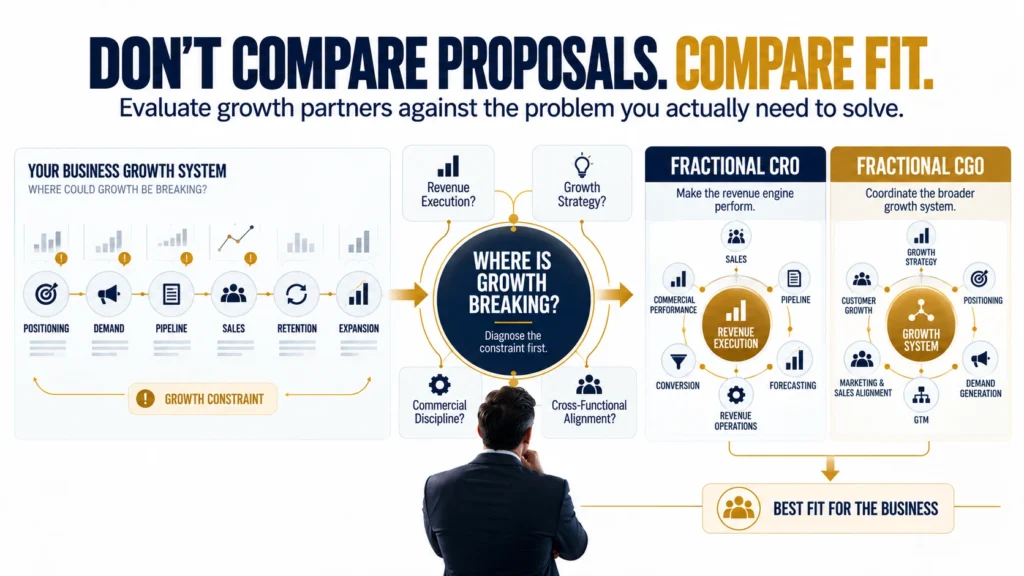
Growth-stage companies often reach a point where marketing, sales, and customer success are active but revenue growth still lacks a unified direction. This is where fractional cro vs fractional cgo becomes an important leadership question. Both roles can provide senior-level fractional growth leadership, but they are not necessarily designed to solve the same business problems.
A Fractional CRO typically centers leadership around the revenue engine, including sales, pipeline, forecasting, commercial performance, and revenue operations. A Fractional CGO generally has a broader growth mandate spanning strategy, positioning, demand generation, go-to-market, customer acquisition, retention, and cross-functional growth initiatives.
The distinction matters because hiring the wrong type of executive leadership can leave the underlying growth problem unresolved. The right choice depends less on the title and more on where the company currently has its largest strategic gap.
What a Fractional CRO Owns
A Fractional Chief Revenue Officer is primarily responsible for improving the organization’s revenue engine. The role typically sits across sales, pipeline management, revenue operations, forecasting, and commercial performance.
A revenue growth executive may be brought in when a company already has a defined market and offering but needs stronger revenue discipline and commercial leadership.
Typical areas of ownership include:
| Revenue Area | Fractional CRO Responsibility |
| Sales strategy | Define sales priorities, processes, and targets |
| Pipeline | Improve pipeline creation, quality, and movement |
| Forecasting | Establish reliable revenue forecasting |
| Revenue operations | Align people, processes, data, and systems |
| Sales performance | Improve conversion and sales execution |
| Account growth | Strengthen expansion and retention opportunities |
| Revenue accountability | Connect commercial activity to revenue targets |
The CRO perspective is fundamentally commercial. The central question is often:
“How do we make the revenue engine more predictable and efficient?”
For example, consider a B2B SaaS company generating consistent leads but struggling with pipeline conversion. Marketing produces opportunities, sales teams are active, but forecasts frequently miss the mark.
In this situation, the primary problem may not be demand generation. It may be sales process, qualification, pipeline management, forecasting, or revenue operations. A Fractional CRO can focus executive attention on these areas.
The role can also become valuable when founders remain heavily involved in sales decisions and need an experienced executive to establish accountability across the commercial organization.
What a Fractional CGO Owns
A Fractional Chief Growth Officer generally operates with a broader growth mandate.
Rather than focusing primarily on the revenue organization, the CGO looks at how multiple functions contribute to sustainable growth. This can include marketing, sales, customer success, product, positioning, demand generation, and go-to-market strategy.
A fractional growth consultant or fractional chief growth officer may therefore become especially relevant when the business has a fragmented growth system rather than a single revenue-function problem.
Typical areas of ownership include:
- Growth strategy
- Market positioning
- Customer acquisition
- Demand generation
- Go-to-market strategy
- Sales and marketing alignment
- Customer retention and expansion
- Growth experimentation
- Product-market alignment
- Performance measurement
- Strategic growth planning
The CGO question is broader:
“What needs to change across the growth system to create sustainable revenue growth?”
For example, imagine a funded SaaS company with a strong product and capable marketing team but inconsistent pipeline growth. The company may be targeting multiple customer segments, using disconnected acquisition channels, and struggling to determine which market opportunities deserve investment.
The problem is not necessarily sales execution alone.
The company may need stronger positioning, segmentation, channel prioritization, demand generation, and GTM coordination. In this situation, fractional growth leadership can address the broader system.
This is where the CGO role can overlap with growth strategy consulting, business growth consulting, and revenue growth consulting.
Where the Roles Overlap
Although CRO and CGO responsibilities can differ, there is significant overlap.
Both executives may work with:
- Marketing
- Sales
- Customer success
- Executive leadership
- Revenue data
- Growth KPIs
- Forecasting
- Customer acquisition
- GTM strategy
- Organizational alignment
Both can also act as an executive bridge between strategy and execution.
| Area | Fractional CRO | Fractional CGO |
| Revenue strategy | Core responsibility | Core responsibility |
| Sales leadership | Primary | Often involved |
| Pipeline management | Primary | Involved |
| Forecasting | Primary | May oversee |
| Marketing alignment | Strong | Strong |
| Demand generation | Supports | Often owns strategically |
| Positioning | Supports | Often strategic owner |
| GTM strategy | Commercial focus | Broad growth focus |
| Customer expansion | Strong | Strong |
| Product alignment | Usually indirect | Often strategic |
| Growth experimentation | Selective | Broader responsibility |
This overlap explains why companies sometimes struggle to determine which executive role they actually need.
The important distinction is not the title. It is the scope of accountability.
A CRO generally concentrates on making the revenue engine perform.
A CGO generally looks across the broader growth system that produces and compounds revenue.
McKinsey similarly describes CROs as leaders responsible for creating a connected revenue engine spanning marketing, sales, customer success, and the broader customer journey.
Where They Diverge
The clearest difference appears when looking at the starting point for each role.
A Fractional CRO typically begins with the revenue number and works backward through pipeline, sales execution, conversion, forecasting, and commercial operations.
A Fractional CGO typically begins with the growth opportunity and examines the broader system required to capture it.
Consider the following framework:
| Business Question | CRO Lens | CGO Lens |
| Why are we missing revenue targets? | Pipeline, sales, conversion, forecasting | Entire growth system |
| Why is pipeline weak? | Revenue channels and sales pipeline | Positioning, demand, channels, GTM |
| Why is CAC increasing? | Revenue efficiency | Acquisition strategy and growth model |
| Should we enter a new market? | Revenue potential | Market, positioning, GTM, acquisition |
| Why are teams misaligned? | Revenue accountability | Cross-functional growth model |
| How should we scale? | Commercial infrastructure | Overall growth operating system |
A company entering the U.S. market, for example, may need more than sales leadership. It may need market entry strategy USA, positioning, segmentation, channel selection, demand generation, and go to market strategy consulting.
That broader challenge is generally closer to a CGO mandate.
On the other hand, if the company already has clear positioning, established demand, and a proven market but cannot reliably convert opportunities into revenue, the central issue may be closer to CRO ownership.
The distinction is therefore about the business constraint, not which title sounds more senior.
Which Role Fits Which Growth Problem
Founders can use a simple problem-based framework before deciding.
Choose a Fractional CRO when:
- Sales execution is inconsistent.
- Revenue forecasting lacks reliability.
- Pipeline management is weak.
- Sales and marketing targets are disconnected.
- Revenue operations require restructuring.
- The company has a validated market but struggles to commercialize efficiently.
- Sales leadership capacity is missing.
- Account expansion and commercial performance require executive ownership.
Consider a Fractional CGO when:
- The company lacks an integrated growth strategy.
- Marketing generates activity without predictable business impact.
- Positioning or differentiation is unclear.
- Demand generation is inconsistent.
- Multiple acquisition channels compete for investment.
- Marketing, sales, product, and customer success operate in silos.
- The company is entering a new market.
- The business needs broader growth consulting services rather than sales leadership alone.
- Founders need strategic growth leadership while execution teams already exist.
Decision Framework
| Current Business Situation | Leadership Need |
| Strong demand, weak sales conversion | Fractional CRO |
| Poor forecasting and pipeline visibility | Fractional CRO |
| Sales organization needs leadership | Fractional CRO |
| Marketing and sales are disconnected | CRO or CGO depending on root cause |
| No unified growth strategy | Fractional CGO |
| Weak positioning and differentiation | Fractional CGO |
| Unclear GTM strategy | Fractional CGO |
| Entering a new market | Fractional CGO |
| Multiple growth functions lack coordination | Fractional CGO |
| Both revenue execution and growth strategy are weak | Potentially one executive with a clearly defined combined mandate |
The most important step is diagnosing the constraint before choosing the title.
A founder should ask:
- Is our primary problem revenue execution or overall growth strategy?
- Do we already have a validated market and positioning?
- Is pipeline volume the issue, or is pipeline conversion the issue?
- Are marketing and sales problems symptoms of a broader strategic gap?
- Do we need commercial leadership, growth leadership, or both?
A useful internal diagnostic is to map the current customer journey from market awareness through acquisition, conversion, retention, and expansion. Identify where performance breaks down before assigning executive ownership.
This prevents companies from solving a strategic problem with additional sales capacity or solving a sales problem with another layer of marketing strategy.
Can One Person Hold Both Titles?
Yes, but the title matters less than the defined mandate.
A sufficiently experienced fractional revenue executive may be capable of operating across both CRO and CGO responsibilities, particularly in a growth-stage company where organizational boundaries are still developing.
However, combining both roles requires explicit accountability.
A company might define the executive’s mandate as:
Growth strategy → Demand generation → Pipeline → Sales → Retention → Expansion → Revenue
In this model, the executive effectively becomes an embedded growth team leader, connecting strategy and commercial execution.
This can be practical for founder-led businesses, funded startups, and growth-stage B2B companies that are not yet ready to hire multiple C-level executives.
But combining the responsibilities can also create problems if the scope becomes too broad.
Before hiring one person for both roles, leadership should define:
- Revenue ownership
- Growth ownership
- Decision rights
- Reporting structure
- KPIs
- Sales responsibilities
- Marketing responsibilities
- Product involvement
- Customer success involvement
- Executive meeting cadence
The company should also distinguish strategic ownership from tactical execution.
For example, a fractional executive might own the growth roadmap, revenue model, channel priorities, and executive reporting while internal specialists or external partners execute campaigns and operational work.
This model is particularly relevant when a company already has execution teams but lacks senior strategic direction.
GrowAnant approaches this type of challenge through strategy-first growth leadership, connecting growth strategy consulting, demand generation, GTM planning, and revenue-focused execution rather than treating marketing as an isolated function.
The broader principle is simple:
The right executive role should follow the company’s growth constraint.
A CRO-oriented mandate makes sense when commercial execution and revenue performance are the primary constraints. A CGO-oriented mandate makes sense when the company needs broader coordination across strategy, marketing, sales, customer experience, positioning, and growth systems.
Organizations also benefit when executive responsibilities are designed around clear operating models rather than titles alone. McKinsey’s research on growth operating models emphasizes the importance of connecting teams, governance, capabilities, and strategic direction around growth objectives.
Frequently Asked Questions
No. A CRO generally has a primary mandate around revenue performance, sales, pipeline, forecasting, and commercial operations. A CGO typically has a broader mandate covering the overall growth system, including strategy, positioning, demand generation, GTM, customer acquisition, and cross-functional growth.
There is no universal answer. A SaaS company should identify its primary constraint first. If the product has established demand but sales execution and revenue forecasting are weak, CRO leadership may address the immediate gap. If positioning, demand generation, GTM, and cross-functional growth are the larger challenges, CGO leadership may be more relevant.
Yes. An experienced fractional executive can potentially cover both mandates when the responsibilities, decision rights, KPIs, and reporting structure are clearly defined. The company should avoid combining the roles without establishing what the executive is ultimately accountable for.
Compensation varies based on scope, experience, time commitment, company stage, industry, and engagement structure. A fractional executive typically operates under a part-time, retainer, or contract arrangement rather than a full-time executive employment model. The appropriate structure should reflect the scope of responsibility and expected level of executive involvement.