
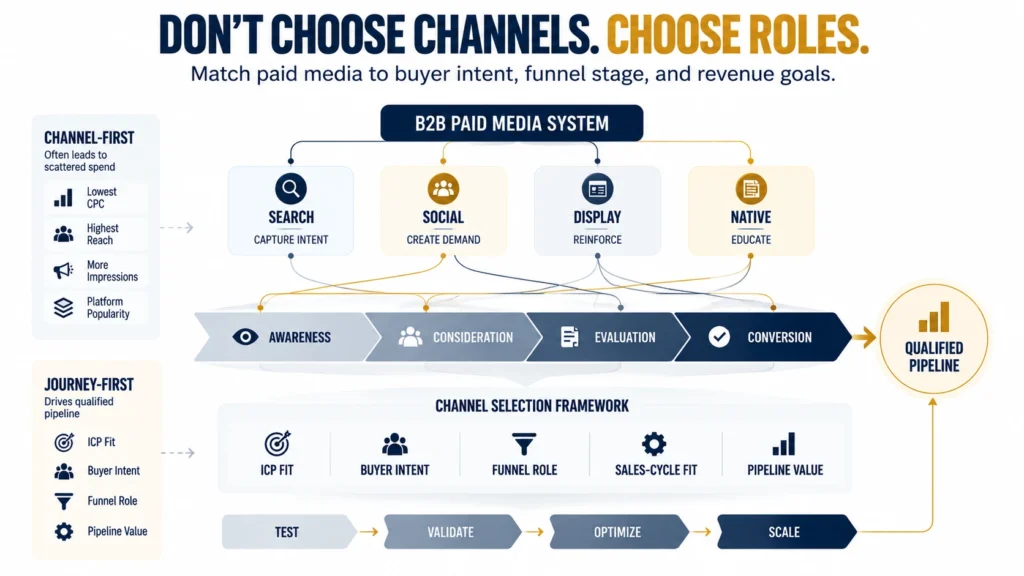
Choosing the right b2b paid media mix is not simply a question of which platform has the lowest cost per click. For B2B companies, the more important question is which channel can reach the right buying audience at the right stage of the decision process and eventually contribute to qualified pipeline.
A strong b2b paid media strategy therefore connects channel selection to intent, audience quality, sales cycle, deal value, and funnel stage.
This matters particularly for b2b tech paid media, where a SaaS or technology company may need to reach a narrow audience with a long buying cycle. Search can capture existing demand, while social, display, and native can create awareness or influence buyers before they actively search.
Google describes Search ads as a way to reach people actively searching for relevant products and services, while its Demand Gen products are designed to create and convert demand across more visual environments.
The strategic question is not:
“Which paid channel is best?”
It is:
“Which combination of channels supports our customer journey and revenue model?”
Search Ads for B2B
Search advertising is usually strongest when a buyer already has identifiable intent.
Someone searching for “manufacturing ERP software,” “managed cybersecurity services,” or “B2B demand generation agency” is expressing a different level of intent from someone who encounters a sponsored post while browsing LinkedIn.
This makes Search particularly useful for capturing existing demand.
| Strength | Limitation |
| High intent | Competitive keywords can be expensive |
| Clear connection to buyer problems | Limited audience when search volume is low |
| Easy to map keywords to offers | Does not always create new category demand |
| Strong for bottom-funnel campaigns | Requires strong landing pages |
| Useful for high-value services | Poor targeting can create irrelevant clicks |
Google’s current Search guidance emphasizes matching keywords and ads to relevant searches and using bidding strategies aligned with business goals.
For a B2B SaaS company, Search can therefore be particularly valuable around:
- Category searches
- Competitor alternatives
- Solution-specific searches
- High-intent service searches
- Commercial problem searches
- Branded searches
- Bottom-funnel comparison terms
However, search should not automatically receive the majority of the budget.
If your category is new, poorly understood, or has limited search volume, Search may capture existing demand without creating enough incremental demand to support the company’s growth objective.
This is where growth marketing services and B2B lead generation services need to work beyond keyword selection.
The key KPI should ultimately move beyond clicks toward qualified opportunities, pipeline, and revenue contribution.
Paid Social for B2B
Paid social works differently.
Instead of waiting for someone to search for a solution, social platforms allow businesses to reach audiences based on professional characteristics, interests, behaviors, company attributes, or other available targeting signals.
For B2B, social can therefore be valuable for creating awareness, educating buyers, promoting thought leadership, retargeting website visitors, and supporting account-based programs.
A B2B cybersecurity company, for example, might use social advertising to reach technology leaders with content about emerging security risks before those prospects actively search for a provider.
Paid social is particularly useful for:
- Category education
- Problem awareness
- Thought leadership distribution
- Retargeting
- Account-based campaigns
- Webinar promotion
- Research reports
- Executive content
- New-market awareness
| Search | Paid Social |
| Captures existing intent | Creates or influences demand |
| Keyword-led | Audience-led |
| Often bottom-funnel | Often mid or upper funnel |
| Problem is already recognized | Problem may need education |
| Strong for direct response | Strong for reach and consideration |
The mistake is evaluating social using exactly the same expectations as Search.
If a social campaign is designed to introduce a new category, its immediate purpose may be to influence consideration rather than generate immediate sales calls.
This is also why demand generation agency strategies often combine social with retargeting and conversion-focused channels instead of treating social as an isolated lead source.
For B2B companies, social performance should therefore be evaluated through a broader funnel:
Reach → Engagement → Qualified traffic → Conversion → Opportunity → Pipeline
Display and Programmatic
Display advertising can extend reach beyond active searchers and help maintain visibility across the buyer journey.
It can be particularly useful for:
- Retargeting
- Account-based advertising
- Brand reinforcement
- Category awareness
- Market expansion
- Content promotion
- Re-engagement
Programmatic buying can add scale and audience targeting, but scale is not automatically valuable.
A B2B company can generate millions of impressions while reaching relatively few people who have meaningful influence over a purchase.
That creates one of the central display risks:
High reach does not necessarily equal high commercial value.
For example, a U.S. industrial software company targeting plant managers and operations executives should not evaluate display primarily on impressions. The more important questions are whether target accounts are being reached, whether qualified prospects return to the website, and whether exposure contributes to eventual pipeline.
Display decision checklist
Before investing heavily in display, ask:
- Is our ICP sufficiently defined?
- Can we identify relevant accounts or audiences?
- Do we have strong creative assets?
- Do we have enough website traffic for meaningful retargeting?
- Can we measure post-click and post-view behavior?
- Do we have a clear role for display in the funnel?
- Can we connect campaigns to account or pipeline activity?
Display becomes much more strategically useful when it supports a defined job in the GTM system.
This is particularly important when comparing performance marketing services USA providers. A provider should be able to explain not just where ads will appear, but why that inventory matters to the company’s target accounts and revenue model.
Native Advertising
Native advertising places sponsored content within an environment where it resembles the surrounding editorial or content experience.
Examples can include:
- Sponsored articles
- Industry publication placements
- Newsletter sponsorships
- Recommended content
- Sponsored research
- Executive thought leadership distribution
Native can be particularly relevant for complex B2B purchases because buyers often need education before they are ready to speak with sales.
Consider a professional services company selling a high-value transformation engagement.
A direct “Book a Call” advertisement may have limited appeal to someone who does not yet understand the problem.
A sponsored research report or expert guide explaining the business challenge may generate stronger consideration.
Native therefore works best when the company has valuable content and a credible point of view.
It can also complement generative engine optimization for b2b saas and broader content strategy by distributing authoritative material that supports the company’s category narrative.
The limitation is measurement.
A native campaign may influence buyers who later return through Search, direct traffic, referrals, or sales outreach. If attribution is simplistic, its contribution can be underestimated.
Choosing Channels by Funnel Stage
There is no universally correct channel mix.
The right combination depends on where the company has the largest growth constraint.
| Funnel Stage | Primary Objective | Suitable Channels |
| Awareness | Reach relevant buyers | Paid Social, Display, Native |
| Problem Awareness | Educate market | Paid Social, Native, Display |
| Consideration | Build credibility | Social, Native, Search |
| Evaluation | Capture active intent | Search, Retargeting |
| Conversion | Generate qualified opportunities | Search, Retargeting, Account-Based |
| Expansion | Re-engage existing accounts | Social, Display, Customer campaigns |
This framework should also be considered alongside account based marketing vs marketing automation.
ABM is primarily an account and buying-group strategy. Marketing automation is primarily a system for managing engagement and workflows. Paid media can support either, but neither is a substitute for deciding which accounts and buyers matter.
For example, a B2B SaaS company targeting 200 strategic U.S. accounts could use:
Paid Social → Account awareness
Native → Category education
Search → Intent capture
Retargeting → Consideration reinforcement
Sales outreach → Opportunity creation
That is a channel system rather than a collection of disconnected campaigns.
Budget Allocation Framework
Budget should follow the role each channel plays in the revenue system.
A practical starting framework for a B2B company testing multiple channels could be:
| Channel | Starting Role | Illustrative Budget Share |
| Search | Capture high-intent demand | 30-45% |
| Paid Social | Audience creation and demand | 25-35% |
| Display | Retargeting and account reinforcement | 10-20% |
| Native | Education and credibility | 5-15% |
| Testing Reserve | New opportunities and experiments | 10% |
These percentages are illustrative planning ranges, not universal recommendations.
A company with strong existing search demand may allocate more toward Search.
A company entering a new market may need more awareness investment.
A company with substantial website traffic may get more value from retargeting.
A startup with low brand awareness may need more demand creation before expecting Search to scale.
Google’s current advertising ecosystem itself reflects this distinction between capturing existing demand through Search and creating demand through visual formats such as Demand Gen.
A practical allocation process
Step 1: Identify existing demand
Look at commercial search volume, branded demand, sales inquiries, and existing pipeline sources.
Step 2: Identify demand gaps
Determine whether the market knows the problem, the category, or the company.
Step 3: Match channels to the gap
Use Search to capture intent and Social, Display, or Native to create or reinforce demand where appropriate.
Step 4: Establish conversion economics
Define acceptable cost per qualified opportunity, pipeline contribution, and customer acquisition economics before scaling.
Step 5: Keep an experimentation budget
Do not commit the entire budget to channels that already appear familiar. Reserve capital for controlled tests.
Channel selection scorecard
Before adding a channel, score it against:
- ICP reach
- Buyer intent
- Audience quality
- Funnel role
- Creative requirements
- Sales-cycle fit
- Measurement capability
- Expected pipeline contribution
- Testing cost
- Scalability
The highest-scoring channel is not necessarily the cheapest channel.
It is the channel with the strongest strategic fit for the current growth problem.
For example, a B2B SaaS company may discover that Search produces the strongest immediate conversion rate, while Paid Social consistently influences target accounts earlier in the buying process. Cutting Social simply because its last-click CPA is higher could remove an important part of the demand-generation system.
This is where a B2B growth marketing agency or strategic growth partner should add value beyond campaign management. The goal is to connect B2B marketing, channel economics, customer journeys, and revenue outcomes.
GrowAnant approaches paid media within that broader growth system, using strategy, demand generation, GTM priorities, and measurement to determine where paid acquisition fits rather than treating media buying as the growth strategy itself.
References
Google Ads
Reach the Right Customers with Search Ad Campaigns
HubSpot
Organic Marketing Secrets in 2026: Why Paid Ads Aren’t the Only Answer
Frequently Asked Questions
There is no single best channel for every B2B company. Search is often strong for capturing existing high-intent demand, while Paid Social, Display, and Native can support awareness, education, retargeting, and consideration. The best channel depends on the ICP, buying cycle, market maturity, deal economics, and funnel constraint.
No. Equal allocation is rarely the strategic objective. Budget should reflect each channel’s role in the customer journey, its ability to reach the ICP, historical performance, testing requirements, and contribution to qualified pipeline.
Yes, when it has a defined role. Display can be useful for retargeting, account-based campaigns, brand reinforcement, and market awareness. It becomes difficult to justify when the company cannot identify its audience, measure meaningful engagement, or connect the activity to broader pipeline goals.
Start with a defined hypothesis, limited budget, specific audience, clear conversion event, and predetermined evaluation period. Establish success criteria before launching, separate the test from existing campaigns where possible, and evaluate qualified pipeline rather than relying only on clicks or impressions. Scale only after the channel demonstrates a credible role in the broader growth system.